From a Remote Kondus Village to Engineering College: Ali's Journey
April 12, 20266 min read
Ali grew up in a one-room house in upper Kondus where the nearest school was a two-hour walk. Three years on from his first trust scholarship, he is in his second year of mechanical engineering. This is how he got here.
Ali (we've changed his first name at his family's request) was eleven years old the first time he thought seriously about quitting school. His father had fallen from a rooftop while helping a neighbour repair their home and broken his back. Medical expenses were the most the family had ever carried. Ali's older brothers left school immediately to pick up work wherever they could find it. At home, his mother did the arithmetic the way rural Pakistani mothers do arithmetic, not on paper, but in her head, late at night, worrying. There were five children. There were school fees for three of them. There was a winter coming.
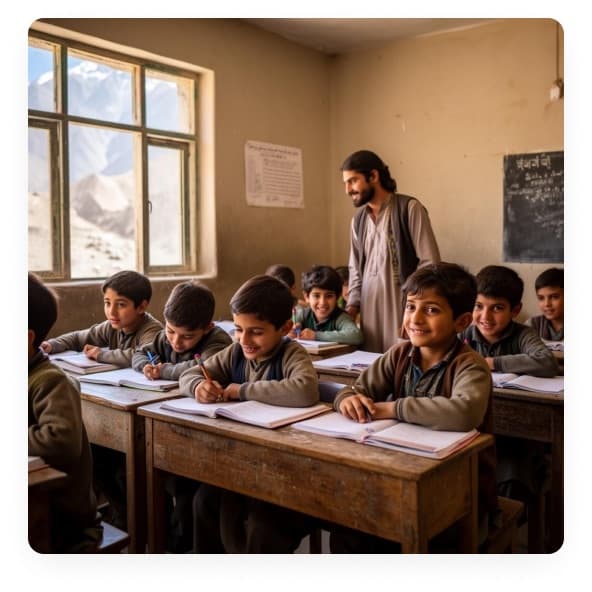
She decided Ali would keep going. His teachers had told her more than once that he was exceptional in mathematics. She didn't fully understand what that meant; she had attended school only until the fourth grade herself. But she had seen his notebooks and she trusted the teachers. So Ali walked, two hours each morning, two hours each evening, along a track that clung to the side of a gorge and closed for weeks at a time in winter, and kept his place in the only government high school in reach. That was 2019. Ali was twelve.
Matric at the top of his class
By the time he was fifteen and sitting for his Matric examination, Ali had stopped being quietly exceptional and started being loudly exceptional. His first-term scores were circulated around the village as if they were the first snowfall of the season. The headmaster of the school, a man who had seen many promising students lose their chance over the years, called Ali's mother and suggested she apply to Al Mehdi Falahi Trust. He had helped other families through the application process before. He offered to help with Ali's.
Ali and his mother came down to the trust office in Kondus on a cold February afternoon. His mother wore the black shawl she only brought out for funerals. Ali, wearing the same sweater he had worn to school that morning, spent most of the meeting looking at his shoes. When the trust coordinator asked him why he wanted the scholarship, he answered in a single sentence: 'Because if I don't get it, I have to stop.' It wasn't a performance. It was a statement of fact.
Three weeks later the trust called with the decision. Ali had been awarded a full Matric Merit Scholarship. The annual amount, PKR 50,000 at the time, covered the rest of his tenth-grade fees, his full books, two sets of uniform, and the monthly transport he now needed because his family no longer had the animals to lend him for the walk. He sat his boards in May with his mind on the exam instead of on his father's back.
The gap year that wasn't
Ali's Matric result came back with a ninety-one percent aggregate, placing him in the top three students in his district. Conventional wisdom in his village said he should now help his family for a year before thinking about further study. Girls from Kondus who scored that high routinely stopped there; boys frequently took jobs in Skardu or left for Karachi. Ali's parents had both half-expected, half-hoped that he would do the same. It would be a reasonable decision.
The trust coordinator called again within days of the result. There was another track, FSc Pre-Engineering, at a college in Skardu, and the trust would top up his scholarship to cover tuition, boarding in a small co-op hostel for students from Baltistan villages, and a preparatory course for the ECAT entrance exam. Ali didn't need persuasion. His parents, who had not previously considered sending a child that far, took three days to decide. His mother told the coordinator at the end of those three days that the answer was yes, but only if they could come and see where he would live. The trust paid for her bus ticket to Skardu.
Skardu, and the first year
Ali's first few months in Skardu were hard in ways he hadn't expected. He had thought the challenge would be academic, and it was, slightly. He had never studied physics at the pace his college ran. He had never sat in a classroom of thirty students competing for the same national exam. But the harder thing was being alone. He had never lived away from his mother's kitchen. In Kondus, even when study was hard, he was surrounded by cousins and neighbours who rotated through the house every afternoon. In the hostel he shared a single room with a boy from another district and ate institutional food in silence.
What got him through was what the trust had quietly set up in the background. The coordinator in Skardu, herself from Ghanche, checked in by phone every two weeks. A small peer group of other scholarship recipients met on Friday afternoons for a study circle. When his homesickness got bad enough that he called home crying in October, his mother told him the trust had asked her what they could do, and the next day a care package arrived with the dried apricots she sent in the mail every winter, already there. He laughed at that, the simplest possible intervention, and it was exactly what he needed.
ECAT day
Ali's FSc result was strong enough that he cleared the ECAT cut-off for several good engineering universities. He chose a government engineering college in Punjab, respectable, affordable once you account for scholarship support, and crucially one that had a small cluster of other Baltistan students. He is now in his second year of mechanical engineering. His father's back never fully healed, and there are still hard months. But Ali sends home a small stipend every month from a part-time tutoring gig that the trust helped him find, and every rupee he sends is a rupee his older brothers don't have to scrape together while working construction jobs.
Ali's family is not rich. They may never be. But the trajectory of the family has changed, and it has changed specifically because a particular scholarship in a particular February went to a quiet twelve-year-old from a one-room house. Multiply that by the fifty-plus students the trust will support in 2026, and then by the hundreds who have come through similar pathways since 2013, and the valley starts to look different. That is how change actually happens, one family, one scholarship, one February at a time.
In his own words
When we asked Ali what he would say to a younger student in Kondus reading this right now, he was characteristically direct. 'Don't wait for things to be easy. Apply even when you think your result is not good enough, let the committee decide, not you. And when you get help, don't forget where you started. My family started in one room. If I forget that room I have nothing.'
Ali plans to return to Baltistan after his degree, work with a regional engineering or infrastructure project, and eventually train younger students himself. He hasn't decided yet whether that will be formally with the trust or independently. But he has decided that he will return. That is a sentence he says without flourish, as a simple matter of fact, the same way his mother does arithmetic.