The Vision and Values Behind Al Mehdi Falahi Trust
April 13, 20265 min read
A close look at the mission, the people, and the values that shaped Al Mehdi Falahi Trust into what it is today, a community-rooted charity serving Kondus and the wider Baltistan region.
When a small group of concerned residents first gathered inside a modest community room in Kondus Valley in 2013, the conversation wasn't about grand ambitions. It was about a child who had just dropped out of school because his family couldn't afford the books. It was about a widow managing winter on one meal a day. It was about a valley so stunning that outsiders called it a paradise, and so forgotten that many of its own young people saw only one future: leaving. That gathering became the founding meeting of Al Mehdi Falahi Trust.
A trust built from, and for, the community
From the first day, the trust was designed differently from how most charities in Pakistan operate. There was no absentee board sitting in Islamabad or Karachi making decisions about villages they had never visited. Every founding member lived in Kondus. Every rupee raised in those early years came from neighbours, relatives, and diaspora families who wanted to help home but didn't know where to direct their generosity. The trust became the answer to that question, a trusted, transparent vehicle through which ordinary people could fund extraordinary change in their own valley.
Thirteen years on, that principle still defines us. The people making funding decisions for a scholarship in Kondus are either from Kondus themselves or have roots here. The people distributing winter supplies know by name the families receiving them. This isn't just about ethics; it's about results. Local knowledge means we don't waste donor money on solutions that look good on paper but fail on the ground.
What we actually do
Our work sits on four pillars, education, welfare, community development, and transparency. They aren't chosen at random. Over a decade of field experience has taught us that real transformation in a place like Kondus needs all four to move together. A scholarship without an accountable system to deliver it just creates resentment. A welfare programme without long-term education work creates dependence. A transparent accounting system without the programmes to back it up is paperwork for its own sake. We refuse to let any single pillar outpace the others.
Education
Education is our largest and most personal initiative. We currently support over two hundred students every year through a blend of need-based and merit-based scholarships, school-fee assistance, and classroom supplies. The programme covers students from Matric through university, with a particular focus on keeping girls enrolled, in a region where girls' education often ends at puberty, every year a girl stays in school is a year that rewrites her family's future.
We also invest in schools themselves. Over the years we've funded textbooks and stationery kits for under-resourced primary schools, contributed to furniture and heating for classrooms that used to close in winter, and paid for short teacher-training workshops when we could arrange them. These are unglamorous line items, but they're the kind of small, specific investments that compound into something real over a generation.
Welfare
Our welfare work is quieter, and by design. It covers monthly stipends for widows and orphans, winter rations when the passes close, and emergency medical help for families that would otherwise sell land or take on crippling debt. We don't publicise the names of recipients, dignity is the whole point. What we do publicise is the totals, the distribution logistics, and the audits. Donors see exactly how many families received support in a given month and exactly how much it cost; beneficiaries don't have to see their names on a poster to receive it.
Community development
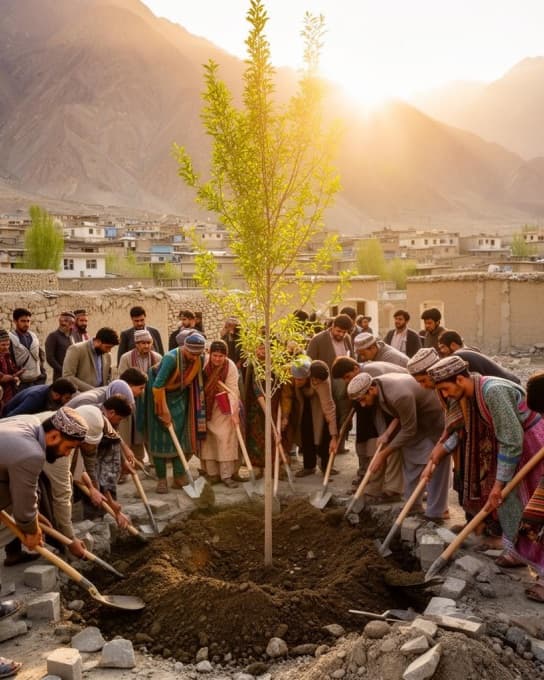
The third pillar is harder to pin down because it changes year to year. Sometimes it's a water-storage project before a dry summer. Sometimes it's co-funding a community medical camp. Sometimes it's coordinating volunteer days when a family has lost everything in a flash flood. The pattern is always the same: we listen first, the community decides, we support.
Transparency, the Amanah Accounts system
The fourth pillar, transparency, is the reason the other three are trusted. In Pakistan, donor confidence in NGOs is not high, and for good reason. We built an internal accounting workflow called Amanah Accounts (Amanah is the Arabic word for a trust or sacred responsibility) that records every rupee received and every rupee spent. Every cash-in entry is counter-signed by a supervisor. Every cash-out entry is approved before a single rupee leaves the treasury. Monthly summaries are published. When a donor asks what happened to a specific gift, we can answer in minutes, not days.
The Kondus context
Why does all of this matter so much in this specific valley? Kondus is in Ghanche district of Gilgit-Baltistan, geographically remote, economically underserved, but culturally rich and historically resilient. The valley has produced doctors, engineers, and teachers who now work across Pakistan and the world; what holds back the next generation isn't talent, it's access. Every scholarship we fund is a small bet that a student who might otherwise have stopped at tenth grade will instead go on to serve their community with a university degree.
The climate adds urgency. Winters in Kondus are long and severe; roads can close for weeks. That means our welfare programme has to pre-position supplies before the first heavy snow, not react after. It means our education programme has to plan around a six-month productive window when families can move freely. We've learned these rhythms the hard way, and we've built the programme around them.
The next five years
Looking ahead, our board has committed to three priorities. First, doubling the scholarship portfolio by 2030 so that no student in Kondus with a Matric certificate and a passing result is turned away for lack of funds. Second, building a dedicated vocational-training partnership so students who don't pursue a traditional degree still have a ladder into skilled work. And third, graduating the Amanah Accounts software from an internal tool into something other small trusts in the region can adopt, because transparency shouldn't be proprietary.
We're a small organisation. We can only do so much in a year. But every year we do a little more than the year before, and every year we carry a little less weight alone, because more people, inside and outside the valley, have come to see what we see: that Kondus is worth the effort. The trust belongs to them now as much as it ever belonged to the founders. That is exactly how it was meant to be.
How you can be part of it
If you've read this far, there is probably something in you that resonates with this work. You don't have to be wealthy to contribute. A monthly donation of a few thousand rupees covers a student's books for a full term. An annual contribution is enough to sponsor a scholarship seat. Volunteering time, professional skills, or simply spreading the word, especially to the Baltistan diaspora, are all ways to be part of the next chapter. The trust has always been a collective effort, and it will remain one.